Guest Post: European Studies for Business Students (Natalia Timus)


timusToday’s guest post comes from Natalia Timus (Maastricht):

One of the challenges of teaching European studies apart from its multidisciplinary character, is a wide target audience interested in this field of studies. This requires a certain degree of flexibility on the part of the instructor in adapting their knowledge and skills to be transferred during the learning process to the specific audience, be it political scientists, historians, economists, or lawyers, for example.

For the second year in a row I have been invited to teach a crash course on the ‘EU and its outsiders’, with a focus on Eastern European neighbourhood, for a summer program of a business school. This represented a new adventure for me and a major challenge for my teaching approach. I was well aware that I have to keep it simple, interactive, and get most of the things done during the classroom, since the course consisted of three days intensive teaching (15 hours) and everyone was looking forward for some beach or sightseeing time in Nice, France.

My first concern in defining my teaching approach was how to optimally talk about business and economic developments from the perspective of a political scientist that I am, and not sliding into the business field that might represent a big mystery to me. For the beginning, I considered important identifying major issues within the field of political economy that might provide a fertile ground for the study of business and political science. Taking into account the multinational profile of my students, as well as the high probability of their lack of any previous background on Eastern Europe or EU external relations, I decided to balance between the time devoted to cover the domestic level transition to democracy and market economy and the external influence, covering both the EU  and Russia.

Now that half of the job has been done, I still had to define the appropriate pedagogical approach I would use. Although I knew little about students’ background, I was informed that there is a large majority coming from the United States higher indication system, but half of them were Chinese, many of them being enrolled both at the BA and MA levels within business calls, some of them were practitioners that decided to use the summer as an opportunity for personal development, and their age varied from early twenties to forties. There was also the division between native and non-native English speakers that I had to be taken into account. In these circumstances, I reflected upon the pedagogical strategy that would provide enough room for everyone to feel comfortable raising questions and taking part in class activities, as well as balancing between individual and team work.

Knowing that case study is a widespread pedagogical approach within the business education, I have conducted a small research for better understanding the use of this method and ended up adapting it to my specific content to be delivered and the time constraints. I chose to work on four case studies engaging students in face-to-face group work during the classrooms and devoting around one hour for each case study.

Apart from that, being a fan of debates, which I have acquired as a learning approach during my high school years, I also inserted two open class debates, where individual student participation was assessed, and one final debate, like a desert for the course, which has been structured as a parliamentary debate and the two groups shared the grade based on their performance.

As I was new with teaching EU studies to business students, their feedback was very important to me. Therefore I have devoted 5 to 10 minutes for debriefing after each day for a joint reflection on the teaching of the learning process, and the final debriefing when I asked the students to reflect on two questions: 1) what course element did you like the most and why? and 2) what could be further improved and how?

I was glad to see that the students felt comfortable enough with providing an open face-to-face feedback additional to the formal evaluation forms that they had to provide to the administration. Overall, they shared the view that the course was well paced, with a good balance between lecturing and interactive parts, as well as regular breaks of five minutes once an hour. They also appreciated the case studies and their class material that they had to prepare on the spot and then take part in group and class discussions. Some of them suggested as a potential improvement a more focused lecture on Russia, taking into account their personal interests in the country, or would have welcomed more in-depth information on the EU, which largely  represented a mystery for them. But all of them liked the fact that there was enough room to ask questions and that I, as an instructor, was feeling comfortable with addressing them, even if they were going somehow beyond the focus of the course.

I must confess I truly enjoyed this unique experience although it required a considerable amount of time and effort for preparing the tailor-made course for teaching the ES to business students. I felt empowered by their positive feedback and it motivated me to improve further for the second year and get more comfortable with my teaching approach. And finally, it just feels special when one as an instructor has the opportunity of introducing for the first time some knowledge to the students and know that it will have a significant impact on their personal development and the way they perceive the world in the future.

Theoretical Theatre: An innovative teaching method for EU Studies: Guest post from Viviane Gravey

This guest post by Viviane Gravey (UEA) was first published on Ideas on Europe.

The European Union has an image problem. The “permissive consensus”[1] (aka non-informed consent) that supported European integration up to the early 1990s is long gone, and the image of “the European construction” as a guarantee of peace is no longer sufficient. Even the last European Commission thought a “new narrative for Europe” was required. Of course, not all of the EU’s legitimacy problems are about its image or European citizens’ lack of information. As important (if not more) is a political debate on whether national sovereignty should be shared, as well as the benefits and drawbacks of shifting power to a supranational level.

As researchers studying European policy and politics, we all make different choices about where we draw the line between raising awareness of what the EU is and what it does and taking a stand on European politics. The possibility of a referendum on British membership of the EU will make this discussion, on whether to get involved and how to do so, all the more crucial. In this post, I suggest that a first and necessary step in engaging the wider public with Europe is to think about how we teach the European Union – and how we can do it better. As a student of EU environmental policies, I have long been keen to draw insights from environmental policy studies for wider EU studies discussions.[2] In this post I go a step further, reflecting on how an innovative teaching practice,  “theoretical theatre”, developed in the School of Environmental Sciences at the University of East Anglia could be adapted to teaching EU studies.

A growing need for better EU studies teaching

What makes the EU complex to teach? Part of the answer comes from the EU political system itself. In many European countries like the UK or France, where citizens are accustomed to a confrontational type of politics, the large number of veto players at EU level and the permeating culture of consensus is decidedly alien. Media coverage of the EU does not always help. EU citizens are often presented with a decidedly skewed account of EU policy-makingand very rarely with informative explanations of what people in Brussels – MEPs, Commissioners, ministers – actually do. Another key difficulty for teaching the EU is the need for teachers to find a balance between the history of European integration, the creation of EU policies, and the opposing theories explaining both. Teachers must find this balance while also trying to engage students in current debates on and in Europe.

How to (better) teach the EU is a topic of growing interest among EU scholars – as evidenced by the 1st European Conference on Teaching and Learning Politics, International Relations and European Studies, by the UACES Student Forum seminar in November 2014 or by the section on Teaching and Learning in a recent Journal of Contemporary European Research issue.  These forums are increasingly discussing innovative teaching approaches, such as greater use of simulations or harnessing the Internet for teaching purposes (see for example the Active Learning in Political Science blog).

Teaching theories, a key hurdle?

Out of the many difficulties encountered when teaching the EU, I suggest one of the key problems is to understand the great variety of theories mobilised to study the EU. This is an especially acute challenge when teaching students with no political science background. Applying theories for the first time – taking a step back and managing to explain the same event or issue with different “lenses” – can be pretty daunting.

A few years ago, researchers in UEA’s 3S research group developed an engaging teaching approach that breaks the ice and introduces students to the use of social science theories: the theoretical theatre. In this approach, a group of lecturers each impersonate a different theory/theorist and engage in a lively debate offering different explanations of an event, or solutions to a problem.

The theoretical theatre approach was first developed to expose students to different theories on sustainable consumption. The theories covered in this sustainable consumption theatre were Rational Choice Theory, Social Psychology, Social Practice Theory and Systems of Provision Theory. Each theory was impersonated by an academic who debated the best way to move toward more sustainable consumption from the perspective of their chosen theoretical perspective[3].

For the last two years, I have helped (with my blog co-editors) bringing together another session in a module on environmental politics and policy. In our theoretical theatre, contenders debate the 1932 Kinder Scout Mass Trespass and the development of access to land rights in the UK from the perspective of Stephen Lukes’ three “faces of power”. Instead of impersonating a theory, we chose to impersonate a theorist, with “Stephen Lukes” going head to head with “Peter Bachrach” and “Robert Dahl” in a performance with an arguably smaller comedic element (although we did use 3D glasses).

Both modules got very positive feedback from the students – which may partly be because the students get to see their lecturers dress rather originally to “get into character”. The different directions in which we’ve taken these modules demonstrate the flexibility of the concept – and is a sign of its adaptability to other fields.

An EU theoretical theatre?

I argue EU studies could benefit from such a theatrical treatment. EU studies is a broad umbrella term for what is a very pluridisciplinary field of study that includes law, political science, history and economics – but the theoretical theatre approach should be flexible enough to be applied to a variety of fields.

What would an EU theoretical theatre look like? In order to be easily understood, it would need to be clearly focused on a specific period in time and issue, with at least 2 (ideally 3 or 4) divergent theoretical readings.

The theatre could serve many different purposes: it could be an introduction to competing readings of an historical period (e.g. the empty chair crisis of 1965 or the 2004 enlargement), to debates on the reasons and modality of a given process (growth in power of the European Parliament) or to a key contemporary issue such as the euro crisis.

For example, a theoretical theatre could be organised around the issue of the EU’s democratic deficit and the role the European Parliament could play in addressing that deficit. Such a discussion might include the four following broadly sketched “theoretical readings”:

theoreticaltheatreEU

Pluridisciplinarity in teaching?

In a complex academic job market, teaching skills are becoming very important for early career researchers. The pluridisciplinarity and diversity of EU studies makes it a perfect field to experiment. The approach I presented here, the theoretical theatre, is only one of many examples of innovative teaching methods being used right now across the UK (and beyond). These methods (theoretical theatre included) may also lead to more pluridisciplinarity in teaching, not just in research.


[1]Down, I. & Wilson, C., (2008) “From ‘Permissive Consensus’ to ‘Constraining Dissensus’: A Polarizing Union?”Acta Politica43, 26–49

[2] For example, I co-organised a panel on “Debating EU Governance: Insights from Environmental Policy Studies” at the 2014 UACES Student Forum conference

[3] The Theoretical Theatre performance is available here.

Simulations for Large Classes: Problematizing Unitary Actors

Today is the first of a series of posts by a guest contributor, Casey Delehanty, doctoral candidate in political science at Florida State University.

Large ClassAs an instructor at a large state university, one of the main challenges of active learning exercises is employing them in large classes. Many existing simulations are designed for classes of 10-30 students, and adapting them to larger classes can be intimidating. Despite this, I encourage folks to think of large classes as an advantage rather than a hindrance. Rather than presenting students with the necessarily simplified world of a small simulation, you can introduce students to even more complex concepts. Here are a few tricks I have picked up from using simulations in classes with 50+ students:

Simulations or games built with smaller classes in mind have to make certain assumptions about the internal decision-making structures of the actors involved. A larger class offers the ability to add internal political structures that introduce students to the notion of juggling domestic interests versus international possibilities. This notion does not have to be limited to simulations of state actors; non-state groups can also be assumed to have internal decision-making structures.

Students who comprise actors that are expected to multi-task in a simulation can be assigned distinct roles to perform. However, a major problem in larger classes is the tendency of some students to free-ride. It is imperative to make roles specific, varied, and incentivized to avoid the following pitfalls:

First, students often do not immediately understand how their roles fit into the overall simulation. As much as this may be obvious to you as the designer, students often need some time fully grasp their role within a larger system of interlinked pieces and what actions they should take in order to maximize their effectiveness. It can be helpful to give students guidelines about possible actions they can take and strategies they might want to pursue. I create advisory guides that are no longer than one page to orient students to the simulation (“your role can determine the fate of X”) as well as giving them some ideas as to how to be effective (“should you want to accomplish goal X, you might want to explore paths A, B and C”). While it is important not to reveal too much and let students find their own path, limited class time makes this kind of advice necessary.

Second, students often obtain the impression that their role is being adequately performed by others within the simulation. This tendency in and of itself can lead to a lecture on free-riding, but it can sometimes alter the balance of a simulation. Moreover, shirking tends to be contagious; if one student is sitting to the side checking Facebook, etc. it will be much more likely for others to do the same. It is therefore important to make student roles unique, so that each student is solely responsible for a single aspect of an overall mission. It can sometimes be beneficial to assign more than one student to a specific role, but I avoid assigning the same function to more than two students in a simulation.

Third, students often lack incentives to play their roles effectively when forced to compete with one another. Sometimes students would rather depart from their role than perform actions that might put them at odds with another student. This can be very damaging to an otherwise effective simulation given that competitiveness between students is often designed as an institutional constraint. To solve this problem, I introduce goals tailored to each actor or group of actors for students to achieve, with “bonus points” as a reward. These goals often compete and conflict with those of other actors, and it is nearly impossible for any one actor (or group of actors) to achieve all of their goals. Instead, these goals function as a tool to incentivize certain behaviors within the simulation. I separate these points from other forms of assessment, since I don’t want the competitiveness of some students to adversely other students’ grades. Instead, I award bonus points for goal completion. These points are, of course, almost insignificant when it comes to students’ final grades, but I find that they generate much more competitive behavior. Students are suckers for points.

Game Lecture on European Democracy: guest post from Jaap Hoeksma

The debate about the future of the EU has been dominated for decades by the dilemma whether the process of European integration should lead to the creation of a sovereign state of Europe or result in a Europe of sovereign states. As recently as 2005 the Belgian politician Paul Magnette published a study under the title: What is the European Union?1 In a rare twist of logic the author refrained from answering the question he posed in the title of his book. Seven years onwards Rosas and Armati concluded their widely acclaimed study on EU Constitutional Law by expressing serious doubt as to whether the EU can ever be defined.2

Friedrich Nietzsche should be remembered for giving his successors a sound piece of advice. The German philosopher suggested that, if you encounter a problem which can not be solved, by no means whatsoever, you should turn in into a game.3 Treading in his footsteps I decided to turn the unidentifiable and unsolvable European Union into a board game, called Eurocracy.euro1

On the board, the EU member states are portrayed according to their size with 1 to 4 cities. Players represent political parties competing for power. They embark on a continuous election campaign through the EU. They obtain Members of the European Parliament (MEPs) by winning municipal elections. Other parties landing on the same city may challenge them in fresh elections, which are democratically decided by the throw of the dice. The may also deal and swap cities in order to get entire countries. The first player to command a qualified majority in the European Parliament, wins the game and is proclaimed President of the European Union…..on condition of sufficient support in the European Parliament.

Eurocracy is played with six persons per game. When played in the class room, the winners on each table are invited to engage in a Speech Battle. They have to deliver a speech in which the propose their priorities on taking office. During this part of the event, the other pupils assume the role of the European Parliament and decide which winner will be the ultimate EU-President.

euro2After play, the teacher/trainer/professor invites the participants to engage in a debate about the EU. Is the EU a state or an organisation of states? What are the characteristics of the Union? Are there differences with other regional organisations and, if so, can you name these differences.

By asking and further questioning, the group arrives at the point where the problem must be faced as to whether the EU fits or does not fit in the Westphalian system of International Relations. This moment constitutes the turning point. It depends on the time available how many minutes or hours are spent on the Westphalian system. It forms the basis of the Organisation of the United Nations and underlies the distribution of international justice. Moreover, it sets the rules for the global financial markets. Currencies function on the basis of the Westphalian paradigm.

However, when the distinguishing qualities of the EU are compared with those of states on the one hand and those of organisations of states on the other hand, it becomes instantly clear that the Union is neither a state nor an international organisation. The implication of this conclusion is that the Westphalian paradigm has lost explanatory value with respect to the EU. As it is a general academic rule that obsolete paradigms have to be replaced, the Westphalian paradigm in international relations should also be substituted with a new one. Since the European Union exists of both citizens and member states, the diplomatic perspective of international relations should be replaced with the civic approach of democracy and the rule of law.

From this point of view, the common feature of all EU member states is their respect for democracy and the rule of law. The famous Copenhagen-criteria for the accession of new member states stress that they should fulfil stringent criteria of human rights and democracy. As the essence of democracy is that the citizens are the authors of the laws, which they themselves must respect, it would appear that this principle has also bearing on the governance of the EU. This line of thought leads to the discovery of the Law of Democratic Integration. Whereas the Westphalian system prescribed that the EU should either become a sovereign state of Europe or establish itself as a Europe of sovereign state, the Law of Democratic Integration holds that, if two or more democratic states decide to share the exercise of sovereignty in a number fields with a view to attain common goals, the organisation they create for this purpose should also be democratic.

At this juncture it becomes possible to draft a Citizens’ Definition of the EU. Beyond the Westphalian paradigm the European Union may be defined as a democratic polity of citizens and member states. The distinctive quality of this polity is that the citizens are entitled to participate in the national democracies of their countries and in the common democracy of the Union.

Martin SCHULZ EP President
EP President Martin Schulz happy to show the Citizens’ Definition of the EU!

In conclusion, it may be suggested that the term ‘common democracy’ is of primordial importance for the EU. Whereas the term is void of meaning in the old Westphalian paradigm, it is obvious from the new perspective that the EU is evolving from a common market to a common democracy.

To visit the game and the present author you may go to: www.eu-president.com

1 Paul Magnette, What is the European Union?, London 2005

2 Allan Rosas and Lorna Armati, EU Constitutional Law, Oxford 2012

3 Friedrich Nietzsche, Ecce Homo, Leipzig 1908

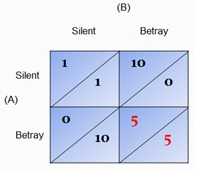
Reflections on a prisoner’s dilemma: guest post from Katherine Wright

In this week’s seminars for our first-year module Introduction to Politics: Power and the State, on Rational Choice theory, I ran a prisoner’s dilemma game with the students. Students were told that they had been arrested for a crime along with their accomplice and could not communicate with this partner in crime.

In each of the three seminar groups we played 2 rounds of the game. For the first round I gave them a name of a celebrity (and I settled on Kim Kardashian as someone they MUST have heard of [certainly have here at ALPSBlog]) on a piece of paper. I told them that they were not allowed to show the name they had to anyone else in the class and that if they had their own name to let me know. I wanted to give them the impression that they did not all have the same name and that someone could have their name.

Prisoners dilemma

After the first round I tallied up on the board who had betrayed/stayed silent and asked each student to justify their reasoning.

The second round saw the students given a name of a classmate, someone among the 12 or so students in the class that day.

The students began to see how their perceptions of their classmates influenced their decision to betray them or stay silent. Many in the second round chose to stay silent because they had seen their partner in crime stay silent in the first round, only to find that their partner had completely shifted positions in the second round and they were left feeling betrayed. Perhaps next time I will play the two rounds without the students revealing how they have voted in the first round until after we have played the second round..

Some students spoke about how their conscience would not let them betray their partner, that they had been brought up not to “rat out” someone else or that the their partner in crime  was a friend they trusted. Others were resolutely rational and said that they would not risk 10 years in prison and 5 years was clearly the most rational decision to make.

Surprisingly, among the three seminar groups the first group – just BSc Politics students – was the most rational with the majority choosing to betray their partner in crime. I had expected that the final group – with BSc Politics & Economics students in it – would take the most rational stance, this was far from the case however and in the main they showed a noble sense of camaraderie (along with the second group of BSc Politics & Sociology students)!

For the last two groups, those who took a risk on a longer sentence and acted ‘irrationality’ were rewarded. However, for the first group this was not the case and those who played it safe and acted ‘rationally’ were rewarded. This set the groups up for an interesting discussion on the merits of Rational Choice theory and one in which I think they felt invested – especially given that many of their peers had just betrayed them!

Katharine A. M. Wright is a Doctoral Researcher and Seminar Tutor in the School of Politics, where she holds a Faculty of Arts and Human Sciences Scholarship. Her thesis examines NATO’s implementation of UN Security Council Resolution 1325.

POL1012 Group 1

POL1012 Group 2

POL1012 Group 3

Combining Classes for a Simulation: Things to Consider. A guest post by Dr. Danielle Langfield

This week we feature part 1 of a two-post series on how to run a simulation in a low-enrolled course by teaming up with another professor. The author, Dr. Danielle Langfield, is an Assistant Professor of Political Science at Marist College.


Part 1: Facilitating Conditions

This past semester, I faced a challenge: an insufficient number of students enrolled in my advanced undergraduate Democratization course to run a simulation negotiating the end of apartheid in South Africa. I have included this simulation in the past eight iterations of the course, as it serves to teach a relatively abstract set of arguments about elite interests and their interactions in determining regime outcomes. Before I created the simulation, students struggled with this material mightily, but having students adopt the roles of those elites has helped them master the theoretical and historical material. Only last semester I did not have the minimum of 12 students needed for all the necessary roles. What to do?

My department chair, JoAnne Myers, was teaching Politics of Human Rights at the intermediate undergraduate level and offered her students for the simulation. With the two classes, we had 28 students in total, more than enough to run the simulation. It worked well enough that we have talked about needing to offer the two courses in the same semester in the future so that we can do it again. But that does not mean there were not some lessons to be learned and considerations to take into account when two courses share a simulation.

First, we benefitted from specific circumstances that made it easier to combine classes logistically:

•The topics worked together: This is an obvious prerequisite for a joint activity, but it bears noting. My caution would be to not underestimate the difficulty of finding synergy between two courses, especially if you are extending an existing activity to a second course rather than creating something new for both. JoAnne had to think about how the readings and topics of the simulation could serve the different subject and emphases of her course. Reading Nelson Mandela’s autobiography was appropriate for a class looking beyond the theory of human rights to its application. Adding the simulation near the end of the semester allowed for the politics of negotiating human rights to come to the fore.

•Course syllabi were new and/or easy to change: JoAnne was teaching Human Rights for the first time, so there was no issue in rearranging an old syllabus to ‘make space’ for the simulation.

•Time slots of the two courses were compatible: Democratization was offered in two 75-minute sessions each week during the day, but Human Rights was a two-and-a-half-hour class one evening a week. I taught half of one Human Rights class, to provide background on the South African case and to explain the simulation. Two weeks later, the classes met jointly during the Human Rights evening slot for the simulation itself. Having one of the classes held in one large block of time, at a relatively unusual time of day, meant everyone was available.

•The composition of our student body meant everyone was available: Our student body is mostly traditionally-aged and have more flexible work and family schedules, on average, than do many student bodies. Students in the Democratization course were told on the syllabus and on the first day of class in January that their attendance was required one evening in April. Apparently all were able to make appropriate arrangements to attend the simulation. That would not be possible everywhere. (I also cancelled class when I attended a conference in April, to ‘make up’ the time to my students.)

None of these issues are necessarily insurmountable if your circumstances are different than ours, but they do need to be considered.

In the next post, I discuss the problems we discovered while conducting a joint simulation.

The Benefits of Cheating

Today brings the final post by guest contributor Dr. Tricia Stapleton, Assistant Teaching Professor of Social Science & Policy Studies at Worcester Polytechnic Institute. Her previous posts are here, here, and here.

While the Stars & Triangles simulation was beneficial, it did have some drawbacks.

First, it needed to fit better with a political science approach to trade issues. The activity on Biz/ed is for economics courses. That being said, materials required only minor tweaks to complement the textbook and meet time constraints.

Second, some students initially exhibited derision for the “arts-and-crafts” nature of tracing shapes and cutting them out. However, this attitude disappeared almost immediately once the students began the simulation, and I never experienced a student refusing to participate fully in the activity.

Third, instructors need access to particular materials (paper, rulers, scissors) for the simulation. Based on class size, this might mean an out-of-pocket investment by the instructor. Alternately, instructors can request that students bring their own rulers and scissors. Because of these possible constraints, the simulation may be better suited to smaller class sizes.

CheatingFinally, I’ve had several instances of students trying to “cheat.” Typical forms of cheating include the “less industrialized states” attempting to create star and triangle templates that they can trace in an effort to improve output, and both types of teams attempting to cut multiple sheets of paper at one time. Normally, I prohibit any sort of cheating by students; however, these instances can provide teachable moments that enhance the activity.

If “less industrialized states” attempt to manufacture their own templates, it opens up a conversation on efficiency measures, research, innovation, and the creation and dissemination of knowledge—which in turn can be a stepping-stone for a discussion of Global North and Global South relations. Also this kind of cheating can be used to start a discussion on intellectual property rights, patents, and copyrights, helpful for courses that focus more on international law.

If either type of team attempts to cut multiple pieces of paper at once, efficiency measures and innovation are still appropriate topics for discussion. But, while the top sheet may produce a star or triangle that meets standards, the rest usually fail. This type of cheating can be used to open up conversations on regulatory institutions and product safety. Misshapen stars and triangles don’t present any real risks, but defective real-world products such as cars, foods, or toys do.

When employing games in a classroom, instructors should consider the potential for cheating, where it may occur, and how they can respond to it. Anticipating where cheating might occur helps make it possible for instructors be to use those instances as teachable moments.

TPR in Role-Playing and Simulations

Here is the second post by guest contributor Dr. Tricia Stapleton, Assistant Teaching Professor of Social Science & Policy Studies at Worcester Polytechnic Institute:

After using total physical response (TPR) in my French classrooms, I found three benefits to using it in political science courses.

Physical SkeletonFirst, linking concepts to action leads to higher levels of retention in the student. While the actions taken in political science classes aren’t as literally performative as in foreign language ones, political science instructors can develop role-playing and simulation activities that use TPR. In language classrooms, students may act out commands like picking up a book, walking around the room, or greeting a classmate. In the political science classroom, actions occur in a more imaginary realm, such as students acting out diplomatic negotiations.

Second, instructors don’t need to shy away from creating complex activities to help  students build a knowledge base. TPR research shows that more complex verbal commands result in dramatic improvements in student understanding. With this in mind, however, instructors should ensure that complex activities are focused in terms of learning objectives. Activities shouldn’t be complex for complexity’s sake.

Third, TPR’s focus on a singular learning objective allows higher levels of comprehension and retention of the concepts, while also creating a strong foundation for future skills. As the instructor develops role-playing and simulation activities, a clear learning objective for each stage of the game is important, as well as consideration for how the outcomes can be referenced throughout the semester.

When I incorporated TPR strategies into my political science classes, the goal wasn’t to make students move around just for the sake of using TPR. Rather, I looked for a concept or theory that could be enhanced by game-playing. First, I considered the topics that produced the most anxiety or confusion among my students, and then I examined the viability of these topics into a role-playing or simulation situation: Did the topic lend itself to becoming an in-class activity? Finally, I looked at the logistics of playing a game: how much class time could I devote to it? What would my main learning objective be and how would I meet it? How could I assess the outcomes of the game? I eventually settled on the topic of comparative advantage, which I’ll discuss in my next post.

Guest Blog: Getting Feedback

I’m very pleased to be able to introduce another guest post from Holly Snaith (Aston): if you’d like to contribute, then please just get in touch with any of us.

Simon
I was intending to write an entirely different post for this blog (which I’ll keep in the back pocket for the future). Instead, while mulling over what I’d like to say and browsing recent posts to consider the tone, I was struck by Simon’s last post on student reflections and self-assessment.

This year has been rather a whirlwind as my first year lecturing. In many respects the step up from seminar teaching has been far easier than I might have imagined, but it’s also entailed that I’ve had to think very hard about how to integrate the kind of interaction and mutual learning that I’m used to, into a far more prescriptive physical environment. It’s not so much of an interpersonal challenge to ask a quiet participant in a 10-student seminar what they think in order to boost their reflection and confidence; doing the same in a room of 100 is much more liable to be counterproductive.

One of the ways I’ve been trying to manage this is soliciting regular feedback through a variety of different means, and since interpersonal contact is now less of a reliable barometer (since the students that talk to me tend to be the ones that are more engaged) I have been getting creative. Some methods, I think, have worked better than others, so I wanted to mull them over below:

1. The formal module reflections.

These are standardised across our school and are mostly designed to allow students to assess our performance. While this is obviously valuable and important, it’s not terribly useful to us as teachers since students don’t tend to fill in much by way of qualitative reflection (so knowing that your average response to question ‘the lecturer made the subject interesting’ is 4.36 on a Likert scale of 1-5 doesn’t tell you very much about what you are actually doing right). As with Simon, therefore, I’ve been pushed to trying a few other tricks.

2. Informal module reflections.

I first drafted some informal accompaniments (we do the evaluations on hard copy, so this didn’t require any extra fiddling, although I have considered trying survey monkey via email) asking mostly about what subjects they enjoyed and did not enjoyed, which learning methods they got the most out of, whether and in what ways their confidence and knowledge had improved, and so on.

3. Questions in class.

This is by definition a little shallow in a lecture environment, but I make sure to build pauses into my lectures every few slides, to give the audience the opportunity to ask questions and offer feedback. I find that using the white board and prompting specific topics works well to get the students to volunteer answers, since it puts the focus on my writing things down, rather than on them speaking out loud.

4. Optivote.

My students have gone bonkers for optivote. I’m a little less sold (it works brilliantly in some sessions, but is little more than a gimmick for others) but I found it incredibly useful in interpreting the written feedback where it was potentially contradictory. The week after getting the forms, I used the qualitative sections (scant though it was) in order to get broader feedback. So, if one student said ‘I want more exams, rather than essays’ or ‘I didn’t find the week on the Commission relevant’ or ‘I thought this module was too hard in comparison to first year’, I was able to poll the whole class to find out how widespread this opinion was. The answers tended to be understandably split, but students liked that they were asked what worked for them (and were able to give reflection on topics they wouldn’t have independently thought of), and I liked that I was able to give far more substantive feedback for the module reflections I have to complete to go back to the school.

What have I learnt from this process? Mostly, that I need to explicitly build in reflection at an early stage. Students took it far more seriously when I told them in week one that they were active participants in the learning process and that I needed them to tell me what worked. Some seemed so used to playing a passive role that it wasn’t intuitive to them that they were ‘allowed’ to judge me throughout the process. As a result, I think I would in future run the process in week 1 in order to ask what their expectations of the module were and prepare them for thinking reflexively as they go.